Case Study 8

Automated Reagent Manufacturing

A reagent manufacturing process required operators to repeatedly measure, dispense, mix, and transfer powder and liquid ingredients according to specific recipes. Neuromeka automated these repetitive steps with an Indy collaborative robot, integrating precision weighing, dispensing, mixing, and cleaning into a single workflow.

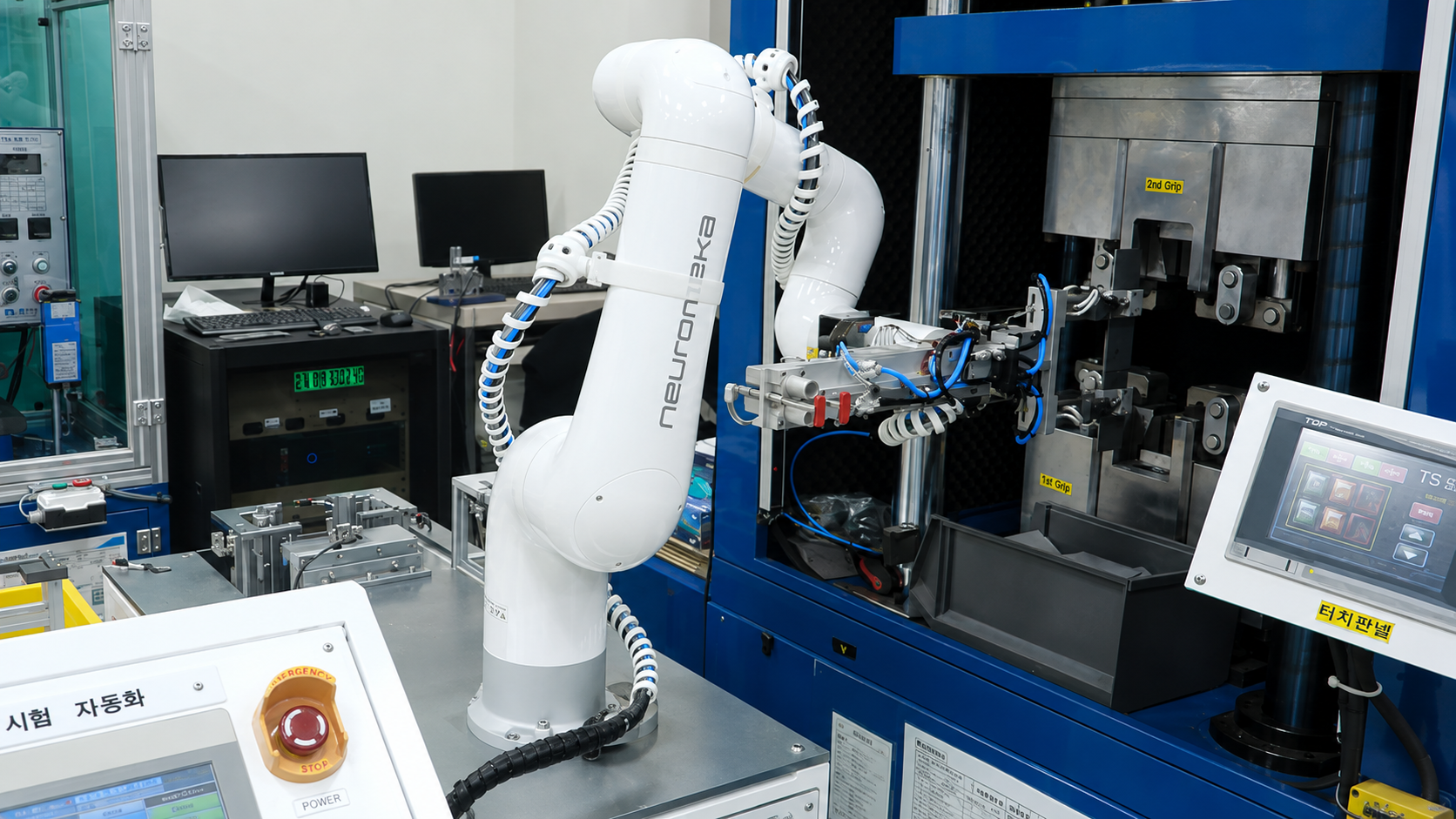
Indy collaborative robot integrated into an automated reagent dispensing and mixing cell
The Indy robot integrates precision dispensing, mixing, and bottle handling into a single automated reagent preparation cell.

Background

Reagent preparation often involves multiple repetitive steps that must be performed in a precise sequence. Depending on the recipe, operators may need to dispense both powder and liquid ingredients, verify quantities, mix the solution, transfer the finished reagent, and clean the equipment before the next batch.

Neuromeka developed an automated system that combines these processes into a single workflow. The operator selects the desired reagent and recipe through an HMI, while the Indy robot and integrated equipment perform the preparation process.

Customer Challenges

  1. Repetitive Manual Handling. Reagent preparation involves repeated dispensing, mixing, transferring, and cleaning tasks. Automating these steps reduces the amount of repetitive work required from operators.
  2. Precise Dispensing. Both powder and liquid ingredients must be dispensed according to the selected recipe. Small variations in dispensing quantity can affect the final reagent concentration.
  3. Multiple Recipes and Batch Sizes. The system needs to accommodate different recipes, dispensing quantities, and reagent bottle sizes without requiring a separate setup for each application.
  4. Continuous Production. Cleaning between batches is necessary to prevent cross-contamination. The cleaning process must also prevent residual rinse water from affecting the next reagent batch.

Deployed Robot Solution

Neuromeka integrated an Indy collaborative robot with automated powder and liquid dispensing units, precision weighing, mixing, transfer, and cleaning equipment.

The system allows operators to select a reagent and recipe through an HMI while the automated equipment manages the repetitive preparation process.

The system includes the following key components:

  1. Indy Collaborative Robot. Coordinates material handling, mixing, transfer, and other repetitive operations throughout the process.
  2. Powder Dispensing Unit. Dispenses powdered ingredients into the reagent bottle while continuously monitoring weight.
  3. Liquid Dispensing Unit. Precisely dispenses liquid ingredients while monitoring the actual dispensed weight.
  4. Precision Scale. Provides real-time weight feedback during dispensing to control the target quantity.
  5. Mixing and Cleaning Unit. Mixes the ingredients to homogenize the reagent and cleans the mixing propeller between batches.
  6. HMI Control System. Allows operators to select recipes, adjust dispensing parameters, and monitor target versus actual dispensing quantities.
  7. Multi-Size Bottle Handling. The system supports 1 L, 4 L, and 20 L reagent bottles.

System Overview

  1. Select Recipe. The operator selects the desired reagent and recipe through the HMI. Dispensing quantities and speeds can be adjusted when production requirements change.
  2. Dispense Ingredients. The system dispenses powder and liquid ingredients into the reagent bottle while monitoring the weight in real time.
  3. Precision Dosing. Dispensing begins at a higher speed and automatically slows as the target quantity is approached, allowing the system to balance speed and precision. The system is designed to maintain dispensing accuracy within ±0.5 g, regardless of the dispensing quantity.
  4. Mix the Reagent. Once dispensing is complete, the mixing system homogenizes the ingredients according to the selected recipe, including dissolving powdered ingredients into the liquid.
  5. Transfer the Finished Reagent. The homogenized reagent is transferred into the designated reagent bottle based on the required bottle size.
  6. Clean for the Next Batch. The mixing propeller is cleaned between production cycles. Separate rinse containers help prevent cleaning water from affecting the next reagent batch during continuous production.
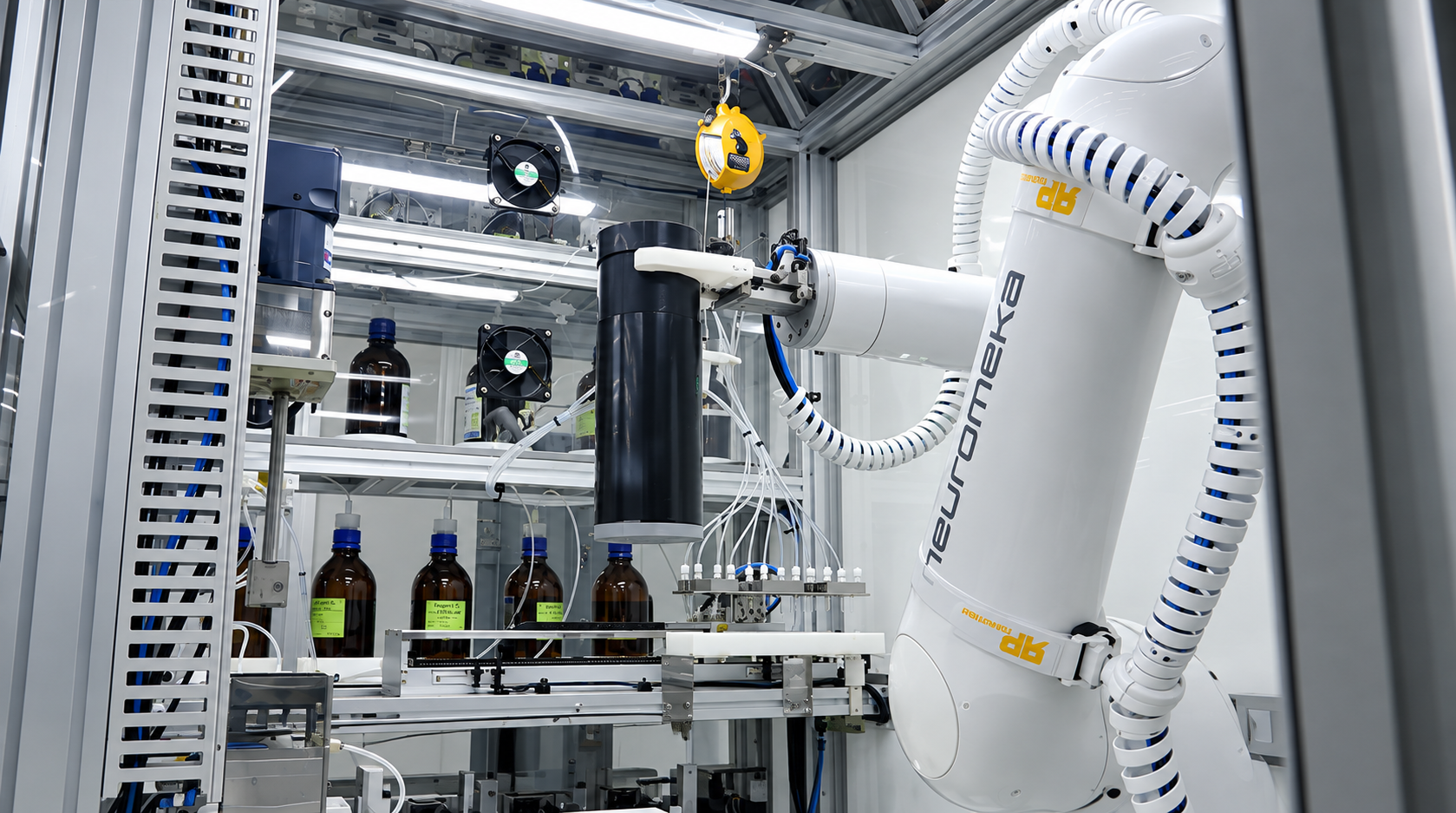
Automated reagent manufacturing cell in operation

Flexible Recipe and Batch Management

The system is designed to accommodate changes in reagent recipes and production requirements.

Operators can:

  • Select different reagent recipes
  • Adjust target dispensing quantities
  • Adjust dispensing speeds
  • Monitor target and actual quantities in real time
  • Select different bottle sizes

This allows the same system to support multiple reagent formulations and production volumes.
Results

MetricBefore AutomationAfter Automation
DispensingManual measuring and dispensing of powder and liquid ingredientsAutomated dispensing with real-time weight feedback, accurate to ±0.5 g
Process StepsSeparate manual dispensing, mixing, transfer, and cleaning stepsSingle integrated workflow from dispensing through cleaning
Recipe & Batch FlexibilityManual setup changes for different recipes or bottle sizesHMI-selectable recipes supporting 1 L, 4 L, and 20 L bottles
Batch-to-Batch CleaningManual cleaning between batchesAutomated propeller cleaning with separate rinse containers to prevent cross-contamination
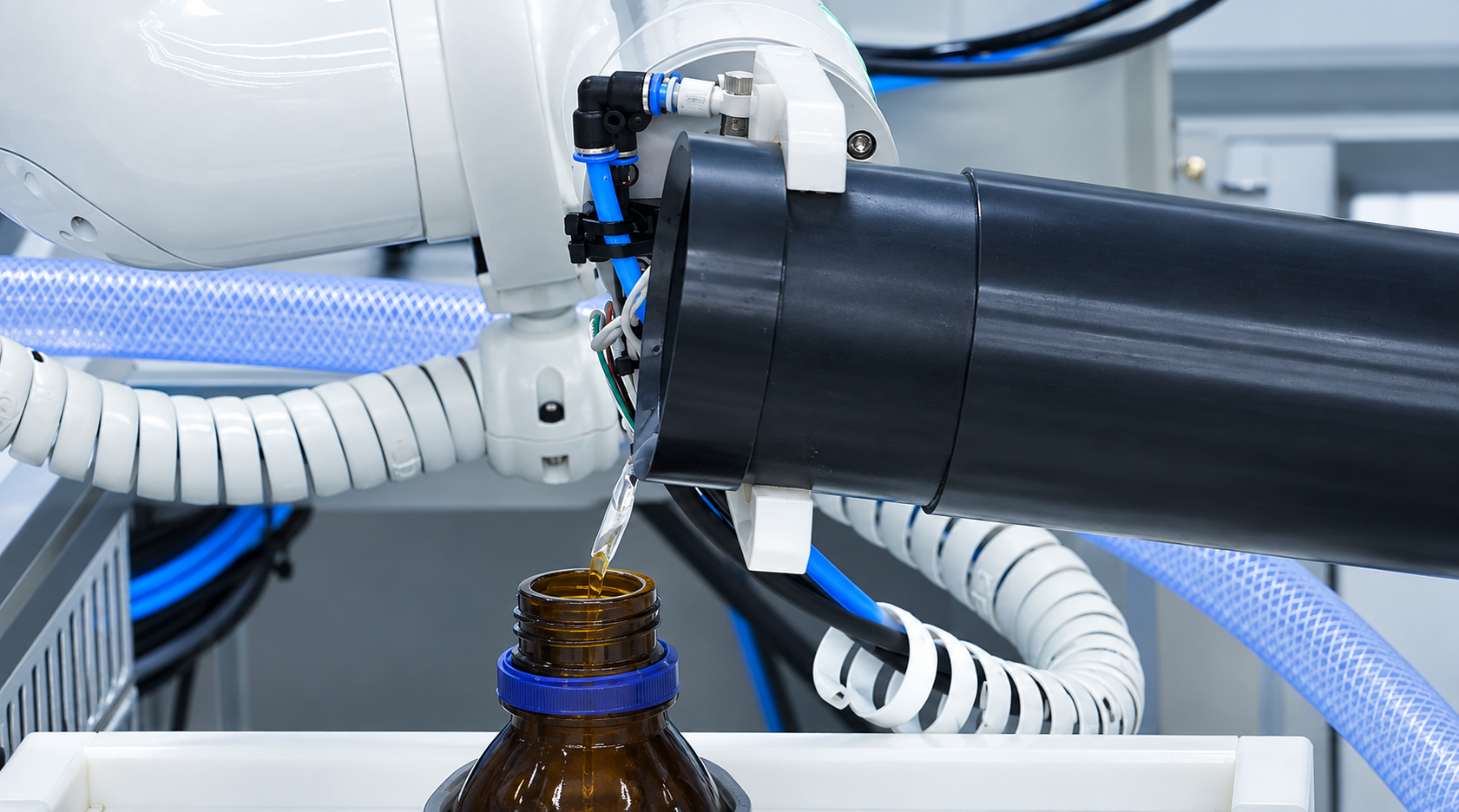
Indy robot dispensing liquid reagent into an amber bottle using a custom dispensing tool
The custom dispensing tool precisely pours liquid reagent into the bottle while monitoring dispensed weight in real time.

Automation Benefits

  1. Precise and Consistent Dispensing. Real-time weight feedback and two-stage dispensing help maintain consistent ingredient quantities, with a dispensing accuracy of ±0.5 g.
  2. Reduced Repetitive Labor. The Indy automates repetitive dispensing, mixing, transferring, and handling tasks, reducing the amount of manual work required throughout the process.
  3. Flexible Production. Adjustable recipes and support for 1 L, 4 L, and 20 L bottles allow the system to accommodate different reagent types and production volumes.
  4. Improved Process Consistency. Automating dispensing and mixing provides a standardized sequence across batches, reducing variation from manual handling.
  5. Continuous Operation. Automated cleaning and material handling support repeated reagent production while minimizing manual intervention between batches.
  6. Improved Operator Safety. Automating repetitive material handling and reagent preparation reduces direct operator involvement in routine process steps.

Contact Us

Share your process requirements, constraints, payload, cycle time, and floor layout. Our team will help you evaluate the right automation solution for your application.

Book a Meeting