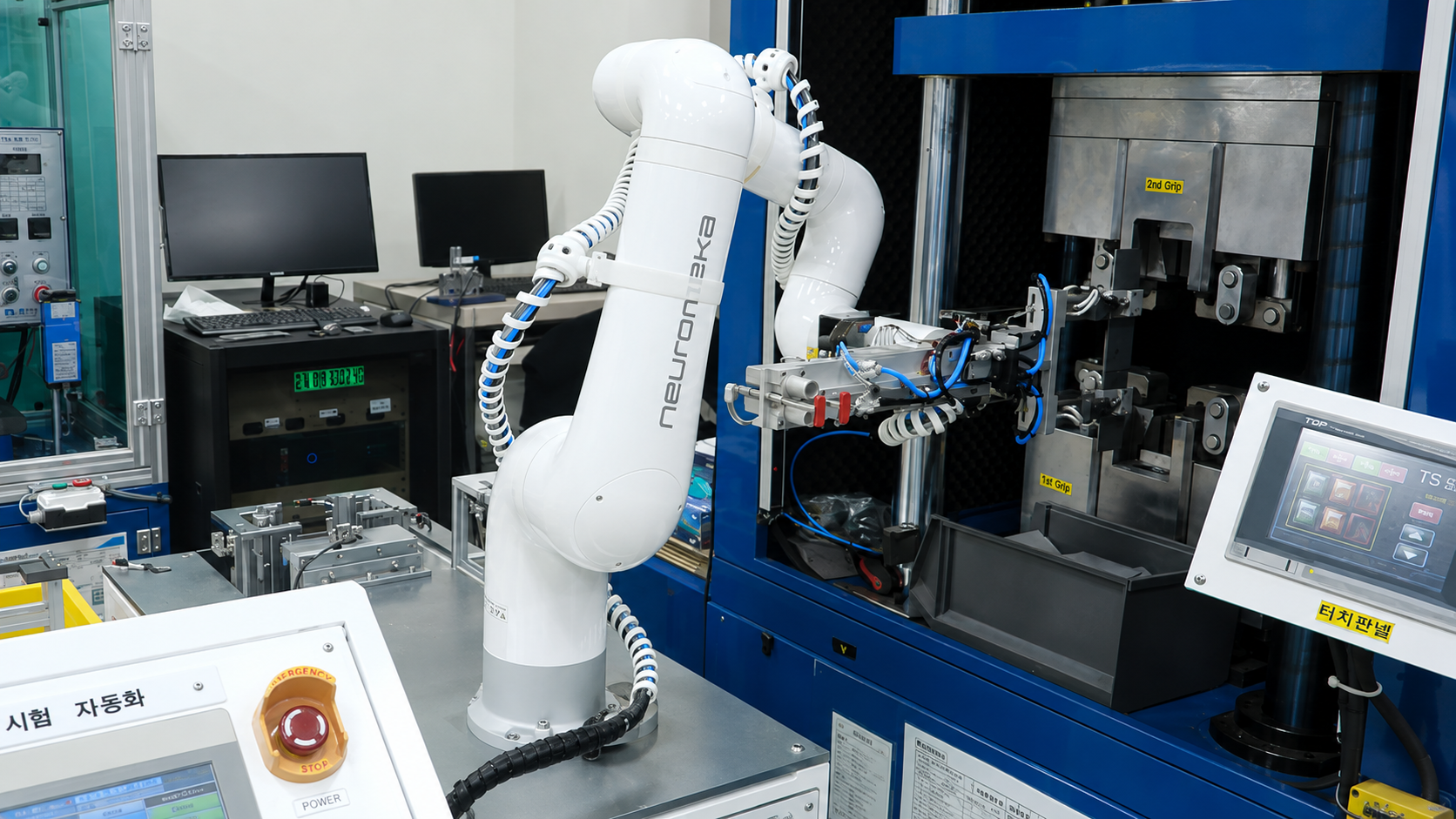
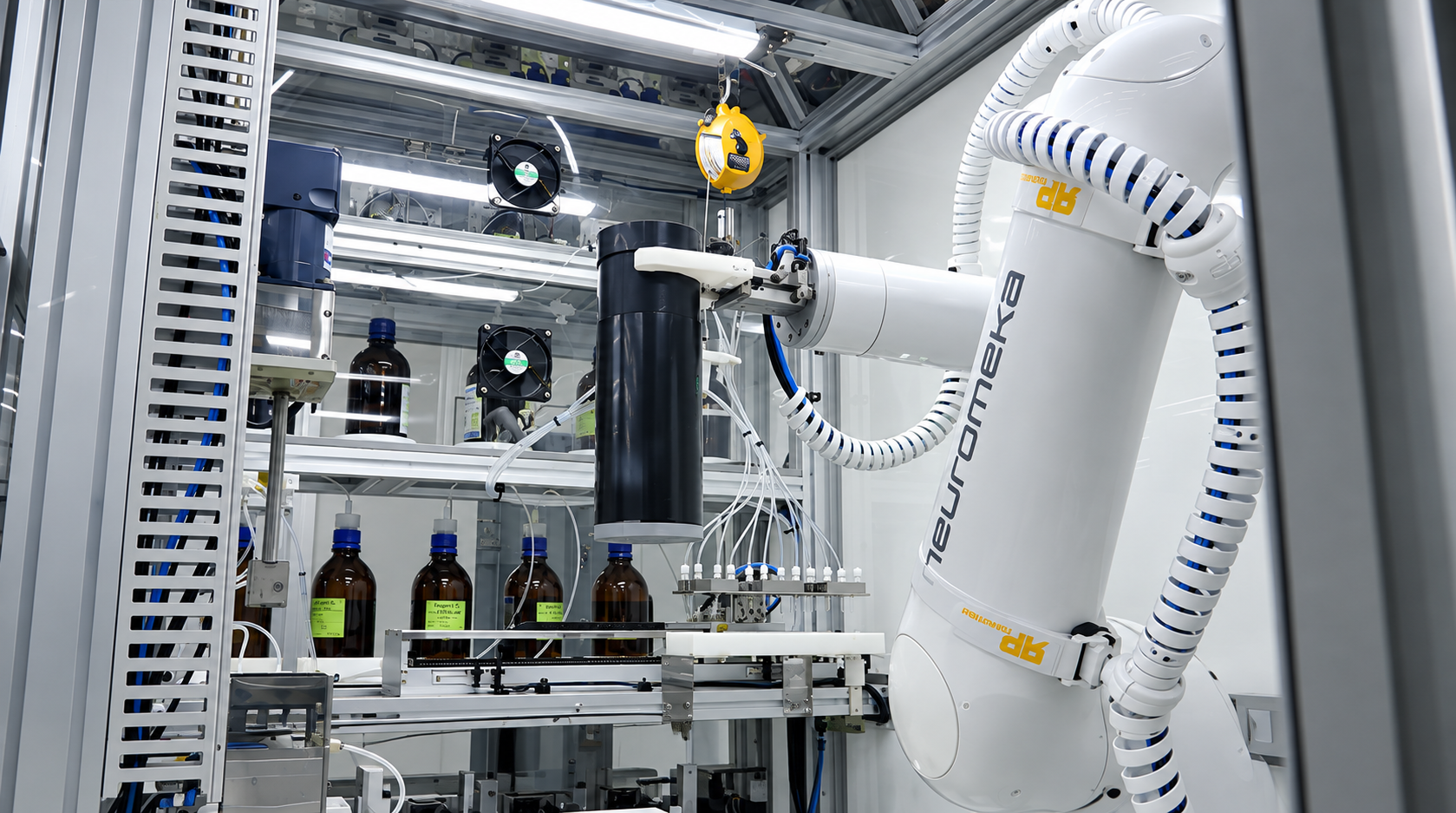
Taillight assembly required precise positioning and bonding of multiple injection-molded components in a post-molding assembly line, with quality and consistency dependent on operator skill level.
The Indy7 assembling red taillight housings using a dual-station jig.
Background
The client is a Tier 1 automotive lighting supplier specializing in rear taillight assemblies for passenger vehicles. Each taillight comprises multiple injection-molded components that must be precisely positioned and bonded in a post-molding assembly line.
Customer Challenges
Labor and throughput limits. Each production line relied on one operator per shift.
Inconsistent quality. Alignment and finish quality varied by operator skill and fatigue, leading to rework and inspection bottlenecks.
Physical strain. Workers manually handled heavy parts repeatedly, increasing repetitive strain injury risk.
Scalability concerns. Increased customer orders were difficult to support without adding floor space or additional labor shifts.
Manual Process Before Automation
Positioning taillight housing components, including red lenses, into custom jigs.
Aligning molded features for accurate part mating.
Performing mechanical joining through alignment and press-fit assembly.
Verifying fit before passing the assembled part to downstream processes.
Deployed Robot Solution
Neuromeka deployed an Indy7 collaborative robot with custom part fixtures and jigs, two-station turntables, pneumatic tooling, inline sensors, and safety enclosures.
The Indy7 performs the following operation flow:
Part Staging. Raw parts are manually or automatically fed to a fixture or tray.
Part Loading. The Indy7 robot picks the part and loads it into the fixture.
Cycle Start. The robot signals the station by I/O or button press to begin the cycle.
Part Unloading. After assembly, the robot removes the part and places it into a finished tray.
Operator Handoff. An operator inspects or packs finished parts as needed.
The customer effectively scaled production with cobot deployment. By automating a skilled but repetitive task, this solution freed human workers for higher-value tasks like QA and rework handling.
The Indy7 performs precision assembly of automotive taillight components, enhancing productivity and consistency on a semi-automated line.
Results
Metric
Before Automation
After Automation
Staffing
1 operator per line per shift
1 robot per line, reduced human intervention
Productivity
100% baseline
200% increase vs. unskilled, 130% vs. skilled
Quality Consistency
Dependent on operator
Standardized, repeatable alignment
Automation Benefits
Stabilized assembly quality.
Doubled productivity without doubling the workforce.
Share your process requirements, constraints, payload, cycle time, and floor layout. Our team will help you evaluate the right automation solution for your application.